
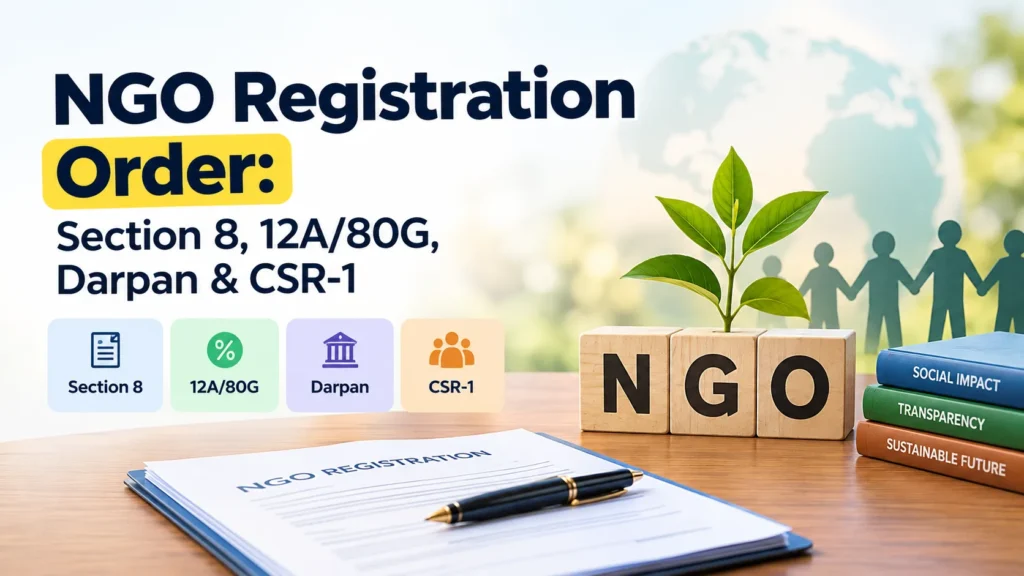
Often, early-stage businesses and non-profit organizations treat Section 8, 12A/80G, NGO Darpan, and CSR-1 as interchangeable checkboxes. But the catch here is that they are not interchangeable because each serves a different role. A Section 8 is a not-for-profit organization structure that provides the legal identity; 12A/80G provides the privilege of income-tax exemptions and donor deductions; Darpan unlocks government grants; and lastly, CSR-1 provides access to corporate social responsibility funding. Assuming these elements are interchangeable checkboxes can be risky; that’s why the sequence matters here.
NGO registration process can be overwhelming if you are going to build a non-profit organization or trying to fix an already running one. This is because the process contains multiple steps, including several forms, many portals, and at this stage everyone has their own opinions on how to manage it. But once you learn how these different pieces fit together one after another, then you can easily avoid the delays that trip up so many good organisations.
Why the Order Matters for NGO Registration?
Sequence matters when registering any organization. You cannot avail the tax exemption privilege unless the organization has legal existence status. Even a company’s CSR team cannot issue funds to a non-profit organization that has discrepancies in its tax-exempt status and does not hold a valid CSR registration number. Most of the government departments ask for the NGO Darpan ID before accepting proposals.
Think of the registration process like building a house. The legal identity serves as the foundation, and tax status is the walls. NGO Darpan and CSR-1 are the doors through which government and corporate funding reaches you. Skipping any single step becomes a costly mistake later; therefore, fixing it the first time is crucial.
Step-by-Step Guide: Follow This Sequence Process
Step 1: Create Your Legal Identity
Before enjoying any privileges, it is crucial for any entity/ organization to exist in the eyes of the law. In India, you can incorporate a non-profit organization by following these three common options:
- Section 8 Company: A Section 8 company is registered under the Indian Companies Act, 2013, which is designed to promote charitable activities like education, art, social welfare, science, and the environment.
- Public Charitable Trust: It is governed by state-specific public trust acts or general trust principles. Its major purpose is to promote social welfare, community development, and humanitarian aid.
- Society: It is an alternative legal structure in India for NGOs or non-profits, governed under the Societies Registration Act, 1860.
There is no single right choice among these three structures, as each has its own benefits and operational requirements. However, a Section 8 company is preferred mostly by the organisation due to its clear governance and chances to grow in the future. Whereas, “Trusts” and “Societies” are much simpler and cheaper to set up compared to a Section 8 company in India.
Once you are registered as a non-profit organisation, you must ensure you fulfil these requirements: get your PAN, open a bank account in the organisation’s name, and read your governing documents carefully (the MoA/AoA, trust deed, or bye-laws).
Why this comes first: Providing the right information is crucial, as the application pulls information from your legal registration. A minor mistake or inconsistency in your name, address, or any other relevant information triggers errors in application filing on the portal.
Step 2: Tax Exemption and Donor Benefits (12A and 80G)
The role of 12A and 80G is different, but these two are tax provisions under the Indian Income Tax Act, 1961. This is how both work for a registered NGO or non-profit organization:
- Section 12A: The Section 12A registration provides access to exemption from paying tax on its surplus income/yearly earnings.
- Section 80G: Donors to the organization can easily claim tax deductions. The whole benefit through Section 80G registration goes to the donor, but it makes a real difference to how easily you can raise funds.
Both Section 12A/80G can be applied for online on the Income Tax portal, and new organizations typically receive a provisional registration first.
Did You Know: The Income-tax Act, 2025 has replaced the 1961 Act from 1 April 2026, and section numbers and forms have been updated. Section 12A has been replaced by Section 332, and Section 80G has been replaced by Section 354.
Why this comes before CSR-1: Before securing the CSR funds, it is mandatory to obtain the Section 332 (12A) and 354 (80G) tax approvals, which act as legal preconditions. This is because the MCA portal requires their registration numbers to file CSR-1, and these approvals protect corporate funding from immediate 30% income tax.
Step 3: NGO Darpan (Your Gateway to Government Grants)
NITI Aayog is the primary governing authority that runs the NGO Darpan. When you incorporate an organization, you get a unique ID that acts as a public profile status. This ID can be seen by any official and founders, even central ministries and government departments, before providing any grants.
Two gentle reminders:
- NGO Darpan registration is neither a certificate of quality nor a guarantee of funding. Through registration, you get a unique identification number, which is used to get access to government services.
- Updating the NGO Darpan ID status is crucial, as old trustee names, expired registration, or contact details that no longer work can trigger a loss of opportunities.
Why the order matters here: The details you mentioned during NGO Darpan registration must be consistent with your legal and tax documents. In case you registered with the wrong identity, you are still required to correct it later.
Step 4: CSR-1 (Opening the Door to Corporate Funding)
Organizations that want to work with companies as CSR implementing agencies file the e-form CSR-1 with the MCA (Ministry of Corporate Affairs). Upon successful approval after filing, the organization gets the CSR registration number. This number is crucial during partnerships with corporate entities.
Here is what to keep in mind:
- Who can apply: The CSR-1 form can be filed by Section 8 companies, registered public trusts, and registered societies.
- What is required: Before filing this e-form, registration under Section 332 (12A) and 354 (80G) is mandatory.
- A professional must certify the form: It must be certified by a CA, CS, or cost accountant.
You cannot file the CSR-1 until you have all official documents ready. The governing authority scrutinizes your legal setup, tax number (PAN), and tax-free certificates before approving funding.
Common Mistakes And How to Avoid Them
These are the common mistakes that you should avoid while going to register a non-profit organization:
Treating the Steps as Interchangeable
Approaching the donors early or filing CSR-1 before registration is a waste of time and results in costly mistakes. Must follow the right sequence to avoid such mistakes.
Inconsistent Information Across Portals
The MCA, Income Tax, and Darpan portals reject the application or raise queries if there are any small spelling mistakes in your name or a mismatched address. Before applying, you must ensure that all records are clean and clear.
Poorly Drafted Objects
The tax authority might raise queries if your objects clause highlights commercial or non-charitable activities. Must verify the object clause before registration, not after.
Forgetting that Registration is Ongoing
Missing the annual compliance formalities like Annual returns, audited accounts, renewals, and timely filings results in hefty fine penalties. But on-time filing keeps your organization’s legal status safe.
Expecting Darpan or CSR-1 to Bring Funding Automatically
Having an ID doesn’t mean you are chosen, but it only means you are eligible. The entities that support funding look only for credible programs with transparent finances.
Also Read – 5 Business Structure Mistakes That Cost Founders Investors
Final Thoughts
If you are feeling the weight of all this paperwork and the multi-step process, then you are not alone. This is because almost every NGO founder goes through the same situation. But managing the whole sequence can help overcome these challenges. First, start with securing the legal identity; second, tax status; third, secure government visibility; and last, CSR eligibility.
To avoid costly mistakes, keep the records clean & consistent, track annual filing deadlines, and follow compliance in a timely manner.