
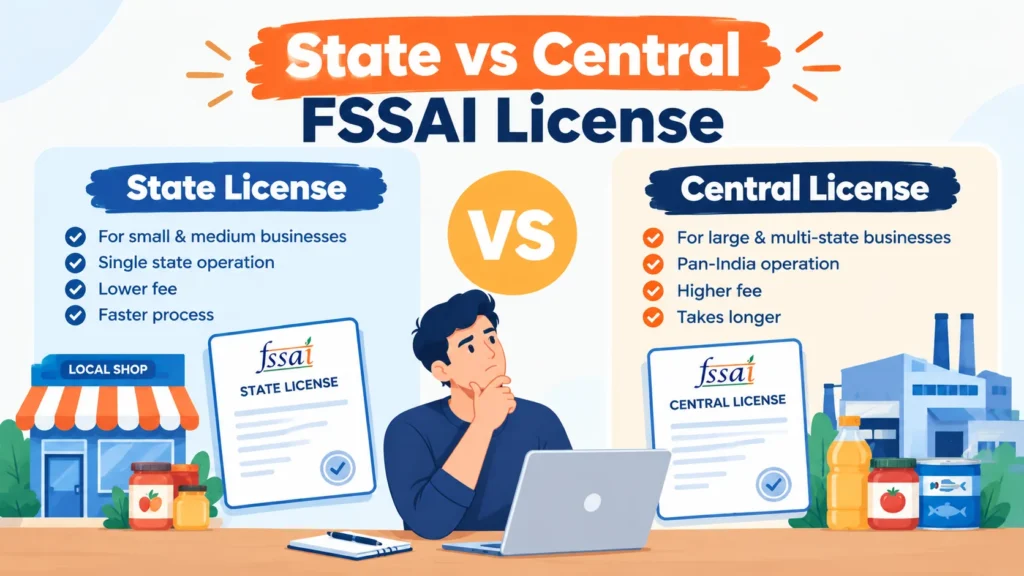
Whether you are operating a small home bakery, a mid-scale restaurant, or a large-scale manufacturing unit in India, meeting the food safety and standards parameters is mandatory. Every food business operating in India is required to register under the Food Safety and Standards Authority of India (FSSAI). But a doubt always remains for almost every new entrepreneur regarding which FSSAI food license they are required to obtain: FSSAI license or Central FSSAI license.
A State FSSAI License applies to food businesses operating within one state, within the applicable turnover band. A Central FSSAI License is required above the turnover threshold, or regardless of turnover for import/export, multi-state operations, or supply to central government bodies. Below the state threshold, Basic Registration applies.
This confusion is understandable. Well, securing either a State FSSAI license or a Central FSSAI license is mandatory, but it depends on the Food Business Owner’s (FBOs) annual turnover. Selecting the wrong food business license triggers to application rejection even yo may face compliance risks. In this comprehensive guide, we explore which FSSAI license is suitable for your food business and why.
Understanding the FSSAI Licensing Structure
The Food Safety and Standards Authority of India (FSSAI) operates food business licensing under a three-tier certification. The FSSAI registration is generally based on the size, turnover, and nature of the food business.
- Basic FSSAI Registration: If your small food business’s annual turnover is up to ₹1.5 crore, then you are required to apply for basic FSSAI registration.
- State FSSAI License: Applicable for all medium-sized businesses with annual turnover between 1.5 crore and ₹50 crore.
- Central FSSAI License: All larger businesses, importers/ exporters, and operations with an annual turnover exceeding ₹50 crore. Even high-risk and multi-state activities also come under the Central FSSAI license category.
As per the Food Safety and Standards (Licensing and Registration of Food Businesses) Regulations, the FSSAI registration/licensing depends on turnover, business type, and operational scope.
What Is a State FSSAI License for You?
The State FSSAI licensing procedure is operated by the state government’s food safety department. This means this license is applicable to food businesses who operating within a single state and have an annual turnover between ₹1.5 crore and ₹50 crore. Meanwhile, it is one of the most common license categories as it covers the various food business sectors like India’s restaurants, small manufacturers, caterers, and retailers.
Who is eligible for an FSSAI State License:
- Small to medium manufacturers (excluding particular high-risk categories)
- Restaurants, cafes, and cloud kitchens with turnover between ₹1.5 crore and ₹50 crore
- Storage units, transporters, and distributors operating within one state
- Retailers and wholesalers of food products at a state level
- Hotels with a certain classification (below 4-star, generally)
Key features of FSSAI State License
- The State Food Safety Commissioner grants the license
- It holds perpetual/lifetime validity.
- The State FSSAI license in India is only valid in a single state.
- It has a much lower fee structure compared to the Central License
What Is a Central FSSAI License?
The Food Safety and Standards Authority of India at the national level plays a vital role in issuing the Central FSSAI license. This central license is specially designed for food businesses with a larger footprint, higher turnover, or those engaged in import/export activities, or that have operating food businesses in multiple states.
Who needs a Central License:
- Businesses with an annual turnover exceeding ₹50 crore
- Importers and exporters of food products or ingredients
- Businesses operating in two or more states
- Large manufacturers, including 100% export-oriented units
- E-commerce food businesses operating at a national scale
- Food businesses supplying to central government agencies, railways, or defence establishments
Key features of FSSAI Central License
- The Central Licensing Authority under FSSAI’s head office issues the FSSAI central license.
- It is legally obligatory for any import/export activity, regardless of turnover
- Required even for a head office if branches exist in multiple states, while the branches themselves may hold state licenses
- Higher scrutiny, strict documentation, but provides broader operational validity across India.
The Core Difference: It’s Not Just About Size
Well, annual turnover is the most common factor that determines the FSSAI food license applicability; however, it isn’t the only one. New businesses often get confused or mistakenly select the wrong license based on revenue. But the catch point here is that the nature of the business equally plays an important role beyond annual turnover.
For example, there is a food business company with annual turnover of ₹10 crore that imports products from abroad and will still need a central FSSAI license. Not because of turnover, but securing the central license is entirely based on the nature of the company’s import activity. In a similar way, your head office of the food business is in Pune, and manufacturing units in Haryana and Punjab will need a Central License for the head office, despite turnover falling under the state license category.
Here is a more simplified version to understand the difference between state vs central FSSAI license:
| Category | State FSSAI License | Central FSSAI License |
| Turnover | ₹1.5 crore – ₹50 crore | Above ₹50 crore |
| Geographic scope | Only for a single state | Applicable for multiple states / Pan-India |
| Import/Export | Not applicable | Mandatory |
| Issuing authority | State Food Safety Department | FSSAI Central Office |
| Validity | Perpetual/lifetime | Perpetual/lifetime |
Common Mistakes Food Businesses Make
1. Assuming turnover is the only criterion
As mentioned earlier, the food business annual turnover is not the only factor that determines which license you are required to obtain. The business type and turnover both determine the criteria.
2. Applying for the wrong license and facing rejection
Before applying for the food business license, you must ensure that your business follows the specific set of criteria set by the FSSAI authority. Match your business type and turnover limit before registration to avoid rejection.
3. Not Accounting for Future Growth
If your turnover is close to ₹40 crore or you are planning to expand the operation into another state after some time, then it is more ideal to apply for a central food FSSAI license rather than converting it later, which requires a fresh, non-transferable application process.
How to Determine Which License You Need?
Before applying for the FSSAI food license, you must ask yourself these questions:
- What is my food business annual turnover?
If your food business’s annual turnover is ₹1.5 crore, apply for basic registration; ₹ 1.5- ₹ 50 crore, a state FSSAI license; and if turnover is above ₹50 crore, then apply for the central FSSAI license. - What if I import or export any food product or ingredients?
If you import or export food products, then you must apply for the central license regardless of turnover. - Do I operate in more than one state?
If yes, then a central license is the primary license for the head office, even if you operate under a unda er state license. - What if I am supplying to central government bodies, railways, airports, or defence units?
If yes, then you must obtain the central license.
In simple terms, a state license is required when you are operating in a single state with a moderate-turnover operation (between ₹1.5 crore and ₹50 crore). If there’s any element of cross-state operation, import/export, or high turnover, the Central License becomes obligatory.
Final Thoughts
Obtaining the FSSAI license right from day one of your business is not only a legal obligation, but it directly impacts your business’s ability to grow, including helping you enter new markets. However, skipping this crucial step leads to complications when expanding business operations or dealing with audits. Start the registration process from day one of your business to avoid unexpected challenges.