
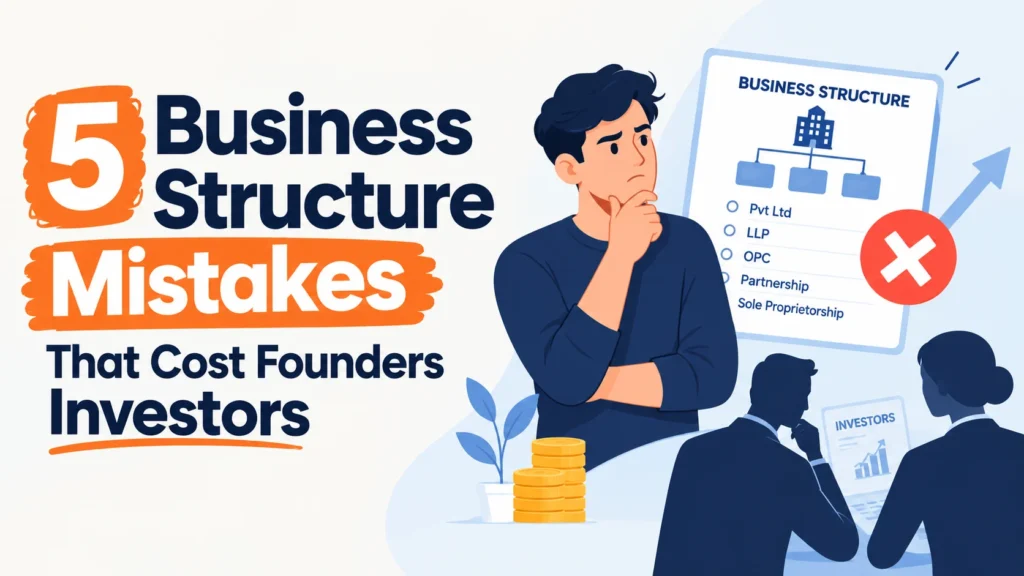
A weak business idea is not the core reason why Indian startups lose the trust of investors. They generally lose the interest of investors during due diligence, most commonly when the legal framework of a business structure do no supports the deal. Think: a founder’s pitch is good, the traction look well, and then the term sheet decides how the company will be set up.
But what is good for you? Every challenge that you face during company registration in India is fixable before you sit across the table to deal with investors. Let’s discuss the five core business structure mistakes that trigger the loss of investors’ interest and with its accurate solutions.
How Does a Business Structure Affect Investor Interest?
Before funding any idea, investors first look for an entity’s legal structure. That shows that an investor does not fund an idea; instead, they fund a legal entity. Before starting the fundraising process, the first step is for investors to hold shares, safeguard their rights as shareholders, and ensure the credibility of the company. That’s where the legal structure of a private limited company plays a major role.
This is because it is the only common structure that allows a business to issue equity shares, grant ESOPs, and have clear governance. So, when an investor looks at your structure then it signals that they are checking how seriously you are operating the business.
Mistake 1: Choosing Proprietorship or Partnership Over Private Limited Company
Sole proprietorships and partnership firms both do not have a separate legal identity from their founders. In results, these business structures cannot issue shares and offer no clear structural path for an investor to own a piece of the company. The biggest reason why founders do not invest in Sole proprietorships and partnerships is that both carry unlimited personal liability.
If you have already registered and are going to convert it into a Private Limited Company, then the process can be extended up to 60 to 90 days or more. It further includes the fees and fresh documentation. If you start fundraising, then the delay can cost you the round.
- How to Fix: If there are any chances to raise external funding within the next 12 to 18 months, then private limited company registration from day one is an ideal choice.
Mistake 2: Choose LLP to Save on Compliance But Seeking to Raise VC Money
Established companies and startups generally consider the structure of an LLP (Limited Liability Partnership) ideal, as it has lower compliance formalities, lower set-up cost, and limited liability protection. But the major problem arises when a founder incorporates as an LLP and then looks for venture capital to raise funds.
But did you know that VCs cannot invest directly in an LLP because this structure cannot issue shares, whereas their funds require actual shares. To raise external institutional funding, the LLP is first required to convert into a private limited company. Even doing fundraising in the middle of an LLP conversion to a private limited company is a red flag investors notice immediately.
- How to Fix: If your goal is not to raise equity funding, then incorporating as an LLP (Limited Liability Partnership) is fine; otherwise, apply for private limited company registration online from day one if your goal is VCs or angel money.
Mistake 3: Messy or Informal Cap Tables
It is one of the biggest reasons why a business loses investors’ trust. It often starts with the initial things, such as the co-founders splitting equity 50-50, taking advice from an early advisor for equity sharing, or issuing the shares without passing the special resolution.
This mess highlights when the internal investigation is conducted by the investor. Beyond paperwork, an investor generally looks for governance challenges. It red flag to investors if they find undocumented promises. This is where an investor loses interest.
- How to Fix: Must keep a clean, formatted, documented cap table with a board resolution behind every allotment. All founders on a standard vesting schedule (typically 4 years with a 1-year cliff) so you earn your equity over time.
Mistake 4: No Founders’ or Shareholders’ Agreement
Signing the agreement by the founder is not only a formality but a legal requirement that defines their roles and how they make decisions, exit policy, non-compliance clauses, etc. During due diligence, the investors usually ask for the founder’s agreement document.
In the absence of this document, the founder usually marks it as an unresolved risk that can raise challenges for them. Funding stage, even bigger deals can be at risk due to incomplete documents.
- How to Fix: During company formation in India, draft an accurate founder’s agreement. It can raise chances for the company to win the trust of investors at the first meeting.
Mistake 5: Owned IP but Fail to Assign to the Company
Even a careful founder can become the victim of this trap. Think: a founder build a codea, product or a logo personally, but never legally signs it over to the company. That’s the biggest mistake a founder can make, which leads to a loss of investor interest.
During due diligence, the investors look for IP ownership. However, if the founder is unclear about IP ownership, then it stalls the deal and results in drops.
- How to Fix: The founders must register a trademark under the company name, not an individual’s. Get signed IP assignment agreements from every founder, employee, and contractor who’s touched the product.
A Quick Self-Check: Is Your Structure Investor-Ready?
Before your conversation with an investor, you must ask yourself these questions:
- Are your plans to raise equity in a Private Limited Company and not in a proprietorship or an LLP? Is a private limited company the Right Business structure for you?
- Do you have complete documentation of your cap table with a board resolution behind each allotment?
- Is there a vesting schedule for each founder?
- Do you have a signed shareholders’ agreement or founders’ agreement?
- Has all product, code, and brand IP been formally assigned to the company, including registered trademarks?
If you have not completed any of the above-listed points, you can fix it early to avoid the due diligence risks.
Frequently Asked Questions!
Q1. Can an LLP raise venture capital funding in India?
Ans. No, an LLP is restricted from issuing shares or equity. To raise Venture Capital (VC) funding, the LLP is first required to convert it into a private limited company.
Q2. Do I need to convert my proprietorship before approaching investors?
Ans. Yes, if your goal is to raise equity funding, then conversion from a proprietorship to a private limited company is required. This is because a proprietorship has no separate legal identity, and it can’t issue shares.
Q3. What’s the biggest cap table red flag for investors?
Ans. Investors do not show interest if a company makes undocumented or verbal equity promises, and there is no vesting schedule for founders.
Q4. Is a founders’ agreement legally required in India?
Ans. Generally not mandatory, but its absence during due diligence can be treated as a serious governance risk.
Q5. How can an LLP secure capital beyond traditional institutional VC funding?
Ans. An LLP (Limited Liability Partnership) can raise capital through partner contributions, debt and bank loans, or government grants.
The Bottom Line
Paperwork is not enough for company registration in India. It generally defines what your preparation before interacting with investors for fundraising. By fixing the above-mentioned five mistakes, you can easily remove one of the most common reasons deals quietly fall apart. Before incorporating the company in India, you must make a four- to five-year plan that determines your fundraising priority.
Keep reading for more information!